

Think You’ve Made It – Think Again.
In trading, a prevalent cognitive bias known as the arrival fallacy often distorts motivation and impairs ability. Coined by psychologist Tal Ben-Shahar, the arrival fallacy describes the flawed assumption that achieving a specific goal—such as reaching a monetary milestone, becoming a full-time trader, or hitting a percentage return target—will deliver long-term contentment. In reality, the psychological payoff is typically transitory, and the emotional baseline quickly reverts, leading to a cyclical sense of discontent.
This fallacy has material consequences in trading environments, where sustainability, discipline, and execution are vital components of your trading process. By overvaluing outcomes and undervaluing process, traders are vulnerable to burnout, erratic strategy shifts, and degraded decision-making.
Implications of the Arrival Fallacy in Trading
The trading domain is inherently adaptive and uncertain – it could be termed chaotic. Yet many traders adopt a linear mental model of progress, assuming that the completion of a defined objective will resolve underlying dissatisfaction or confer psychological stability.
Empirical observation suggests otherwise.
Key behavioural consequences of outcome over process include:
-
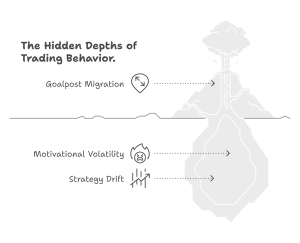 Goalpost migration: Once a milestone is achieved, new benchmarks are set, often with diminishing motivational returns.
 -
Motivational volatility: Traders frequently report a drop in engagement following goal attainment, leading to inconsistency.
-
Strategy drift: The emotional letdown post-achievement can prompt unjustified system modifications or overtrading in search of renewed stimulation.

This dynamic is not a reflection of underperformance, but a misalignment between expected emotional reward and actual psychological adaptation.
Trading is a process of adaptation.
1. Institutionalise Process-Based Metrics
The cornerstone of consistent trading performance lies in focusing on what you can control. Instead of solely fixating on profits and losses, which are influenced by market volatility, concentrate on the elements within your direct influence.
Ask yourself: what aspects of your trading are within your control and can be consistently monitored and measured?
The answer typically includes:
-

-
Adherence to a Trading Plan: Are you consistently following your pre-defined rules for entry, exit, and position sizing?
-
Precision in Execution: Are you executing trades at the intended prices and with minimal slippage?
-
Discipline in Risk Management: Are you adhering to your stop-loss orders and managing your overall portfolio risk according to your plan?

To quantify these behaviours, implement journaling and scorecard systems.
-
Trading Journal: Meticulously record each trade, including the rationale behind it, the entry and exit prices, the position size, and any deviations from your trading plan.
-
Scorecard System: Develop a system to track your adherence to your trading plan, your execution precision, and your risk management discipline. Assign scores to each category and monitor your progress over time.
By focusing on these process-based metrics, you shift your attention from the unpredictable outcomes to the controllable inputs, fostering a more disciplined and consistent approach to trading. What can be measured can be managed.
2. Install Performance Consolidation Phases
Achieving a trading milestone, whilst exciting, can also be immensely destabilising. It can also lead to overconfidence and impulsive decisions. To mitigate this risk, introduce deliberate pause points after achieving a significant goal.
These consolidation phases should be used to:
-

-
Review Performance Drivers: Analyse what factors contributed to your success. Was it a specific trading strategy, a particular market condition, or simply disciplined execution?
-
Re-Anchor to Long-Term Strategy: Reaffirm your commitment to your long-term trading goals and ensure that your recent success aligns with your overall strategy.
-
Reduce Emotional Volatility: Acknowledge and process the emotions associated with your achievement, but avoid letting them cloud your judgment.

These intervals provide an opportunity to reset, recalibrate, and re-enter the market with a clear and objective perspective.
3. Apply Multi-Dimensional Goal Structures
Traditional goal-setting in trading often focuses solely on outcome goals, such as profit targets. However, a more effective approach involves decomposing performance objectives into three categories:
-

-
Input Goals: These are the actions you take to prepare for trading, such as daily market scanning, news analysis, and journaling.
-
Process Goals: These are the behaviours you exhibit during trading, such as adherence to your trading plan, disciplined risk management, and precise execution.
-
Outcome Goals: These are the results you achieve, such as profit/loss targets, win rate, and drawdown.

While outcome goals are important, traders should give more weight to input and process goals in their psychological valuation. By focusing on the controllable aspects of trading, you reduce the pressure associated with achieving specific financial targets and foster a more sustainable and enjoyable trading experience.
4. Document Emotional Patterns Around Milestones
Emotions play a significant role in trading performance, particularly around milestones. To gain a better understanding of your emotional patterns, traders should record not just trade data, but also their emotional states before, during, and after goal attainment.
This documentation should include:
-

-
Pre-Milestone Emotions: How did you feel leading up to achieving your goal? Were you anxious, excited, or confident?
-
During-Milestone Emotions: What emotions did you experience as you reached your goal? Were you euphoric, relieved, or surprised?
-
Post-Milestone Emotions: How did you feel after achieving your goal? Were you satisfied, complacent, or overconfident?

Over time, this practice develops pattern recognition around emotional adaptation and can reduce irrational decision-making post-success. By understanding how your emotions influence your trading decisions, you can develop strategies to manage them more effectively.
5. Reinforce Identity-Based Motivation
The motivation behind trading can significantly impact performance and resilience. Traders who frame their work as identity-driven (“I am a disciplined executor of a defined edge”) rather than achievement-driven are more resilient to emotional volatility and less prone to overreach following goal completion.
Identity-based motivation focuses on the kind of trader you aspire to be, rather than solely on the financial outcomes you seek. This approach fosters a sense of purpose and commitment that transcends the ups and downs of the market.
By identifying with the qualities of a successful trader – discipline, patience, and risk management – you create a stronger foundation for consistent performance and emotional resilience. This mindset helps you stay grounded, even in the face of significant gains or losses, and prevents you from deviating from your long-term trading plan.
The arrival fallacy is not merely a philosophical concern—it is a structural risk factor in trading performance.
Misjudging the emotional utility of goal attainment leads to strategy decay, inconsistent engagement, and avoidable behavioural drawdowns.
Traders seeking long-term consistency must substitute outcome dependency with systems thinking. Psychological durability is achieved not through milestones, but through process adherence, self-awareness, and emotional detachment from results.