

Dog Stocks – Great Entries
Last week, I wrote this piece – Great Stocks, Bad Entries. The idea was to look at whether delayed entry timing had a material effect on returns. I found that entering 40 trading days after the original breakout still produced strong 12-month returns. The conclusion was nuanced yet clear: the quality of the stock dominated that of the entry.
Trending stocks tolerate imperfect timing. Even delayed entries into genuine winners produced meaningful positive returns, suggesting that being in the right vehicle is far more important than getting the precise entry.
If strong stocks are forgiving, are weak stocks punishing — even when the entry is technically refined? Can improved timing salvage a structurally poor stock?
If strong stocks are forgiving, are weak stocks punishing — even when the entry is technically refined? Can improved timing salvage a structurally poor stock? That is the question this study was built to answer.
Great stocks forgive bad entries. Bad stocks punish good entries. Market selection determines returns. Entry quality determines efficiency.
Methodology
Signal Definition
Buy the first close above the previous 100-day high. No chart-reading, no narrative overlay, no subjective judgment. The breakout either occurs or it does not — eliminating all discretionary bias from the test.
Universe Selection
A deliberately weak group of poor-performing stocks from the United States and Australia. Chosen to be the structural opposite of the great-stock universe in the original study.
Entry Variations
Five entry timings tested: immediate breakout day, then +5, +10, +20, and +40 trading days later. Identical to the original study’s delay structure for direct comparison.
Return Windows
Forward returns are measured at 6-month, 12-month, and 24-month horizons. The 12-month window serves as the primary benchmark for comparison with the great-stock study results.
The Results: Timing Changed Nothing
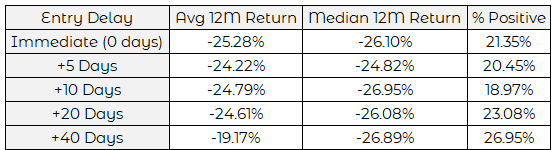
 The answer to the central question was unambiguous. Across the poor-stock universe, the breakout signal itself had poor forward expectancy before any entry refinement was applied. Buying immediately after a 100-day high produced an average twelve-month return of -25.28%. The median return was -26.10%, and only 21.35% of signals were positive after twelve months.
The Mirror Image

The original study showed that great stocks were tolerant of imperfect timing. This study reveals the exact mirror image — and it is the more important finding. Bad stocks are intolerant even of improved timing.
Great Stock · Bad Entry
Still potentially profitable. The instrument’s underlying trend and structural strength absorb the timing inefficiency. The trader participates in the move despite the imperfect execution.
Bad Stock · Good Entry
Still usually poor. A technically refined entry can make the trade feel more disciplined and professional. But discipline applied to the wrong instrument does not create edge — it creates a more orderly way to lose money.
 This is the trap that sophisticated-looking technical work can set for traders. A well-timed entry into a structurally weak stock carries psychological weight. It feels precise. It feels disciplined. But none of that changes what the stock is. The entry may change; the underlying character of the stock does not. A technically neat entry can give the trader emotional comfort while delivering the same poor outcome on a slightly different date.
Pullbacks Do Not Save The Result
 A natural and reasonable objection to the delayed-entry test is that waiting arbitrarily for 20 or 40 days is not the same as waiting for a proper pullback. A disciplined trader might argue: “I would not simply sit out for five weeks. I would wait for a meaningful retracement to a logical support level, then enter with tighter risk.” That sounds like sound practice. But when the same broad pullback logic was applied to the poor-stock sample, the result was still weak — and the reason reveals something important about the difference between strong and weak instruments.
Unlike the great-stock universe — where many of the most powerful trends never offered traders a meaningful second chance — weak stocks pulled back frequently. That is not a sign of opportunity. It is a sign of weakness.
In the poor-stock sample, a 5% pullback occurred in 96.5% of cases, with a median wait of just 7 trading days, and still produced average twelve-month returns of -20.0%. A 10% pullback occurred 90% of the time, with a median duration of 20 trading days, and still produced an average return of 17.1%.
The False Comfort Of A Better Price
One of the most persistent psychological traps in trading is the belief that a lower entry price automatically makes a trade better. It does not.
 The relationship between price and opportunity depends entirely on the character of the underlying instrument, not on the absolute level of the entry. In a strong stock, a lower price after a pullback may genuinely improve the efficiency of a trade that was already going to work. In a weak stock, a lower price may simply be the next stage of deterioration wearing the costume of a discount.
Cheapness Vs Value
Traders frequently confuse a lower price with some form of intrinsic value. A stock trading at a 10% discount to its breakout level is not automatically more attractive — if the instrument is structurally weak, the lower price may be reflecting further deterioration, not a temporary mispricing.
This is one of the reasons fundamental investing fails so often. Practitioners cannot distinguish between cheapness and value – their perception is that the cheaper something is, the better its value. This often leads them to buy stocks until they are delisted.
Patience Vs Edge
Waiting for a pullback before entering is a form of discipline. But discipline is not the same as edge. Applying patience and process to a weak instrument does not generate positive expectancy — it produces the psychological satisfaction of having acted carefully, even as one arrives at a poor outcome.
However, basking in how clever you think you are will not keep the lights on at night.
Price Action As Information
A stock that pulls back 10% after a breakout may look more attractive than it did at the breakout. But in a structurally weak stock, that pullback may be information. The market may be telling you that the breakout failed because there was no widespread participation behind the move.
Fish In Productive Waters
 The trader’s first job is not to find the perfect entry. The trader’s first job is to avoid the wrong stock. This reordering of priorities has immediate practical implications for how traders should allocate their time, their analytical process, and their systematic filters.
Scan quality matters. Market regime matters. Sector strength matters. Liquidity, relative strength, and trend persistence all matter — not as secondary considerations that follow the entry decision, but as the primary filter that determines whether the trader is operating in productive territory at all.
 Capital rarely flows evenly across the market. Instead, it moves in waves, concentrating in industries perceived to benefit from powerful technological, economic, or structural changes. It doesn’t matter if a particular sector is considered to be in a bubble phase – all that matters is that a given segment of the market is outperforming the rest.
Right Market → Right Theme → Right Stock → Right Entry.
Market history is rich with examples of themes that have covered select sectors and, in turn, produced outlier returns within those sectors.

The Bigger Picture
Traders systematically overestimate what timing can achieve and underestimate the importance of being in the right vehicle.
This is not a minor calibration error. It is a structural misunderstanding of where the edge in trading actually lives. The market does not reward precision in isolation. It rewards precision applied to the right opportunity.
A technically refined entry into a weak stock is precision applied in the wrong place.