

Careful What You Wish For
Traders often describe periods when “nothing is working.” Every breakout fails, every exit appears poorly timed, and every missed opportunity seems to confirm that they have lost their touch. This is a universal complaint among all traders – there do seem to be times when absolutely nothing works – or so it seems.
The difficulty is not always the market or the trading system. Sometimes it is the way the brain is filtering the available evidence.
The brain is not a camera recording markets objectively. It is a prediction and selection engine. Faced with more information than it can consciously process, it continually decides what deserves attention and what can be ignored.
Why Your Expectations Shape Your Charts
 The Mechanics of Perceptual Blindness
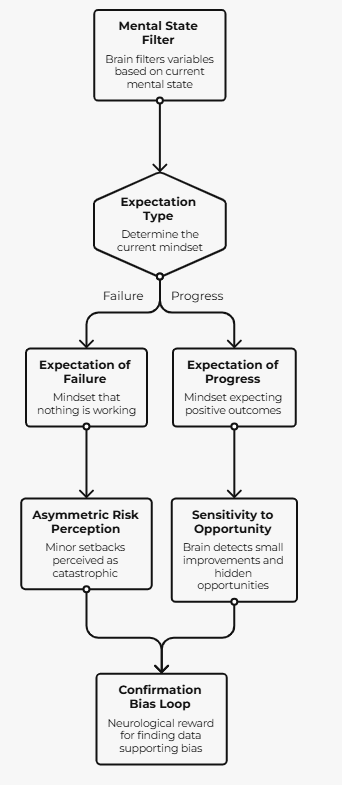
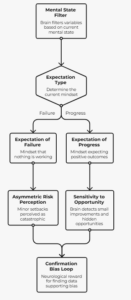
Attention and prediction are inextricably linked in the way you see the world. Your mental state acts as a filter dictating which variables your brain “sees” on the screen and which it ignores.
Expectation of Failure: When you adopt a mindset that “nothing is working,” your brain flags threats and setbacks, leading to an asymmetric risk perception where every minor red candle feels catastrophic.
Expectation of Progress: Conversely, expecting a positive outcome makes the brain sensitive to small improvements and opportunities that were already there but hidden by the noise.
Hardwired Confirmation Bias
This filtering mechanism creates a feedback loop of cognitive dissonance. You are rewarded neurologically to find data that supports your current bias while remaining blind to contradictory price action.
The Neurology of Winning and Losing Streaks
In a clinical setting, neurology patients show how focus shapes physical reality: those expecting failure notice every symptom, while those expecting progress notice “fewer bad days.” In trading, the market data is the “symptom,” but your brain chooses what to amplify.
The Setback-Focused Trader: This trader obsessively tracks one-minute candle fluctuations (the trading equivalent of a physical symptom). They experience every minor drawdown as a system failure and miss the broader trend because their brain is tuned to amplify noise over signal.
The Opportunity-Focused Trader: This trader remains alert to “small wins” and incremental structural shifts. This focus reduces drawdown frequency and speeds returns to equity highs because the brain recognises recovery cues early.
How Belief Drives Trading Behaviour
When your brain predicts failure, the resulting perceptual blindness weakens execution and discipline. Slippage in discipline often results from a brain that no longer believes the plan will yield a reward, causing a breakdown in your edge.
Alternatively, expecting a benefit ensures consistent engagement with your strategy and risk management protocols.
The Brain’s Narrative
“The story your brain tells does not change reality. It changes what you notice within it.”
Why Optimism Isn’t a Strategy
Belief Does Not Override Probability
Optimism is not a trading strategy. You cannot wish your way to success.
Belief does not change the underlying mechanics of price action or the probability of a specific trade outcome. Its true function is to optimise your attention and stress responses, ensuring you have the clarity to recognise progress and build upon it rather than succumbing to emotional paralysis.
Navigating the Filter
Trading effectively requires more than being able to expertly describe how the RSI is calculated; it requires training your brain’s filtering system to recognise the “Alpha” that already exists within the noise. If your filter is tuned to failure, you will remain blind to the very progress you are working to achieve.
You have to continually ask: Is your filter protecting your ego or your equity?